

Todd Burchett and Sentinel Trust’s Investment team take a closer look at the complex connections shaping today’s financial markets. From AI-driven investments to rising interest rates, discover why growing circularity concerns reinforce the value of diversification and a disciplined, long-term perspective.
Please read the full text below or download the PDF version.
Executive Summary
- Aristotle wrote that “the circle is a perfect thing.”[i] Circles are efficient, simply and fully defined, infinitely symmetric and have no beginning nor end. Every point on a circle is equidistant to its center.
- Despite all these qualities, there is no such thing as a perfect circle in nature. It is a man-made construct. We see many imperfect circles in finance and geopolitics today. Most asset classes delivered volatile and negative returns in Q3 with circularity concerns spooking investors.
- While we need to be mindful of these circularity concerns and address them in detail below, we continue to see a diversified and cautious stance as the best path forward.
Cash and Bonds
Cash is often considered the circulatory system of the financial markets. Just as the heart circulates blood and oxygen through our bodies, the Federal Reserve controls the supply and cost of money in financial markets. While we seek maximum blood oxygen levels, the Fed appears to be embarking upon a tightening cycle where they restrict the supply of money and make it more costly. After 66 months of above target inflation, the Fed unanimously voted to hike interest rates in September and just voted to pause in October with two dissents. With inflation stubbornly high, they are expected to hike rates another 2-3 times over the next six months, bringing cash rates closer to 5% from ~4% today. With cash expected to deliver higher yields, we remain overweight.
Turning to bonds, where we remain underweight, we see quite a bit of circularity and volatility. Whereas new Federal Reserve Chair Kevin Warsh’s predecessors preferred to give the market forward guidance as to their expected moves, Warsh has likened this to a “hall of mirrors.” In his recent Jackson Hole speech[ii], he noted “if markets rely materially on the Fed’s guidance and the Fed relies on market prices, we are all more likely to be blinded to new developments . . . more likely to be caught unprepared for a turn of events . . . and more likely to commit errors in policymaking.” When bond yields jumped in Q3 driving longer US Treasury bond prices down by some of “the most significant levels in the last two decades”, Warsh saw this as a positive in his July 29th press conference[iii]. He noted the market was paying attention to real data and “learning to play the ball, not the referee.”
On August 19th though, US Treasury Secretary Scott Bessent took the polar opposite view stating “we believe that the yields don’t reflect the underlying fundamentals”[iv]. Bessent, who has called himself America’s “top bond salesman”[v] announced that Treasury would buy back tens of billions of dollars of longer dated bonds. At the same time, perhaps in the ultimate example of concerning circularity, Treasury needs to sell roughly $2 trillion in new debt to fund America’s near-record deficits of 6% of GDP. For now, the market seems to agree with The Economist which noted, “an accountant might raise an eyebrow…on encountering a salesman who juiced his figures by purchasing his own wares.” 10 and 30-year US Treasury bond yields are higher since Bessent’s announcement with growing concern around America’s $40 trillion of debt. While we remain underweight and concerned with all these issues, we do think 10 and 30-year yields in the 6-7% range would be attractive and may act as a hedge against other circularity concerns in equity markets noted below.
While we have no exposure to private credit, we’d be remiss not to note the growing concerns with confusing circular financing here as well. In Q3, an investigation into asset manager Guggenheim Partners and its CEO Mark Walter was disclosed. Without going into the complex detail, the investigation centers around whether insurance companies owned and controlled by Guggenheim properly disclosed private credit loans made to Walter for his personal purchases of the LA Dodgers, Lakers, and other investments[vi]. While a circle’s perimeter, diameter and area are simply and fully defined by its radius, the bond market appears to be growing ever more complex.
Global Stocks
Turning to equities, the US equity market gained a small, volatile but positive ~1% return in Q3 despite rising discount rates noted above and a host of circularity concerns of its own right. While every point on a circle is equidistant to its center, Q2 S&P earnings growth was hardly spread out equally and displayed other circularity concerns. Q2 earnings, reported in Q3, grew at an incredible ~50% year over year clip for the S&P 500. A third of this though came from just two AI-focused companies- Alphabet and Amazon- and their earnings came largely from investments in other AI companies. Google’s parent, Alphabet, for example had roughly 70% of its quarterly profit or $98 billion come from unrealized gains in its stakes in SpaceX and Anthropic. Similarly, Amazon reported $53 billion in non-operating profit versus just $1 billion a year earlier mainly from its own Anthropic investment. For now, these circular investments are delivering a virtuous returns cycle, but one can easily envision the circle spinning in the opposite direction creating a vicious negative feedback loop. To wit, Alphabet just reported a ~$9B Q3 loss on its outside investments, helping to send its shares to a record market value loss.
While AI chip maker Nvidia also delivered nearly $60 billion of earnings, circularity concerns arise here as well. When Nvidia sells its chips, it recognizes the full sale as revenue and the associated profit as earnings whereas the buyer can depreciate the chips over about six years. At the full S&P 500 level all of Nvidia’s sales are booked as revenues whereas only a sixth of the associated cost to buyers is expensed. Roughly $8 billion of Nvidia’s earnings also came from its equity investments in other AI firms. With its $5 trillion valuation, Nvidia is known as the “central bank of AI” and holds nearly $50 billion in stock of public AI-related companies like Intel and SpaceX but also an additional $50 billion in private stakes including an estimated 32 investments and $25 billion of future commitments to startup AI model-makers[vii]. Most of these firms are the same firms buying Nvidia’s wares but lack the current cash flow to do so.
While international markets also turned in a ~1% Q3 return, circular financing concerns abound here too. After jumping over 60% in the first half of 2026, the AI- and robotics-heavy China STAR market peaked in August at a ~130X price to earnings multiple and has since fallen roughly 30%. The STAR market peaked just as a Chinese humanoid robot crushed Usain Bolt’s 100-meter record before promptly crashing into a barrier with sparks flying[viii]. Chinese robot maker Unitree began trading on the STAR market just days before this event, jumping fivefold before plummeting ~45%. While we can make some guesses as to what the ultimate use of these humanoid robots will be in the future, they are largely useless now. Chinese state-linked buyers are the largest buyers of humanoid robots from Unitree and its scores of competitors who in turn support thousands of suppliers and local governments. China has its very own “hall of mirrors” with its venture capitalists considering which robotics firms are best supported by the government before investing[ix].
Although this type of circular government support may seem like the kind of unproductive planned economic policies western capitalism eschews, we are seeing more instances of it than ever here at home. While Nvidia owns 4% of Intel, the Government of the United States of America is Intel’s largest shareholder with a ~10% stake. In just under two years, the US has announced 43 deals totaling $30 billion[x]. Additionally on July 31st, Secretary Bessent’s to-do list, photographed by Reuters, read “Buy Japanese Yen (JPY) $5-10 bil” and he later noted “I am the house now…bet against me if you want.” When pressed, Bessent argued that a weakening yen could force Japan, the US Treasury’s largest foreign creditor, to sell its bonds and push US interest rates up even further. A complex circle.
While the jury is still out on these and other government related investments, we would like to bring this back full circle to tie it together. The US and China are locked in what many are calling an AI race or a race to super intelligence just as the US was locked in an arms race with the Soviet Union during the cold war. We would argue that unlike a traditional race with a defined finish line, this race, like investing, is continuous like a circle with no defined end. The west won the cold war decades ago and yet here we are with Russia and Ukraine and the US and Iran in deep conflicts many years later. These wars may cool into some negotiated settlement, and we may see some longer-term strategic stability. China is after all the US’s third largest creditor and trading partner, but we expect both sides to continue to run large deficits to support national security via AI and defense initiatives.
While these circularity concerns along with heightened discount rates and geopolitical risk have us slightly cautious on global equities, we should finish by noting that we largely believe investors should stay near fully invested. With the S&P 500 largely flat in Q3 and earnings growing at 30% excluding those investments in other companies, today’s price to expected earnings stands at a reasonable ~19X. With the S&P trading very close to all-time highs, an unusually large ~55% of its constituents are trading 20% below their all-time highs. Mid and small cap US companies, which fell in Q3, stand at ~14X and are much less exposed to an AI bubble. Similarly, developed and emerging international markets trade at ~12X. Investor and consumer sentiment, typically contrarian signals, remain quite dour. In sum, much of the global market appears relatively cheap and unloved, has been left out of the AI trade but may ultimately benefit, and can act as an important diversifier for investors.
Alternative Assets
Aristotle believed the circle was so perfect that it must explain the movement of the heavenly bodies. This belief was held until the 1600s when Kepler observed planets orbiting in an elliptical pattern and Newton described why with gravitational mathematics. In Q3, one hedge fund flew too close to the sun, was brought down arguably by a mix of gravity, hubris and what Newton reportedly called the “madness of people”. After reportedly gaining 1,000% since its inception in September 2024, the highly-leveraged AI-focused fund, Situational Awareness, fell ~70% in July and was forced to sell the bulk of its holding to Citadel’s hedge fund. Situational Awareness’ founder, who purportedly discussed buying galaxies at cocktail parties[xi], was initially backed by investors and followed by many others. The “hedged” directional hedge fund indexes we follow fell much more than global stocks in July and we suspect there was a lot of circular thinking and crowding amongst hedge funds in these AI names. While Situational Awareness has lived to fight another day and has likely delivered exceptional returns for its earlier investors, we continue to set a very high bar for new hedge funds, remain underweight the directional space, and continue to lean into uncorrelated strategies that we hope will stay afloat should the drain circle again. In Q3, when most asset classes including “hedged equities” lost value, we were pleased with a small, but positive return from our uncorrelated strategy.
Turning to real estate, one’s political stance is often viewed in a spectrum, but we often see it as a circle. Comedian Charlie Berens quipped opposition to data centers, the fastest growing real estate sub-sector, was “the most bipartisan issue since beer.”[xii] Recent polls show ~70% of Americans oppose data center construction in their communities with Bernie Sanders, Alexandria Ocasio-Cortez, Steve Bannon and Marjorie Taylor Greene all criticizing the expansion. While there are those, including President Trump, who think the expansion must continue in our strategic AI race against China, data center expansion and real estate broadly face perhaps a larger challenge from rising interest rates noted above.
With AI startups and data center developers generally lacking the capital to build new centers at ~$50 billion per GW, firms across the spectrum are relying on more complex circular financing special purpose vehicles while circling the wagons in a wider and wider arc. Just this week chip-maker Broadcom announced that it spent two months creating a $63B shell company involving itself, Anthropic, Bank of America, Citigroup, Morgan Stanley, and Blackstone to lease its chips to Anthropic in a data center[xiii]. These players are not alone and the circularity and complexity is dizzying to say the least. We included a graphic we created in Claude for illustrative purposes at the end of this note. While rising interest rates knocked listed real estate down 6% in Q3, rising rates plus these circularity concerns have become existential threats for some “neo-clouds” and data center developers like CoreWeave. Around the same time its co-founder said that he would like to tap the “unlimited” debt capital from insurers[xiv], its bond yields topped 15% and its equity lost 35% to trade full circle back toward its post-IPO price. Given this dizzying level of circular complexity and ties to interest rates, we remain underweight real estate and in search of less traveled areas like small outdoor industrial warehouses and senior living facilities.
Turning to venture capital and private equity, the circularity and complexity continues again in astonishing fashion. Anthropic just filed its paperwork to go public later this year at a reported record-breaking ~$2 trillion valuation which would eclipse the ~$1.8 trillion SpaceX IPO just issued in Q2. The IPO filing, its S-1, highlighted many of the dizzying circular concerns noted above along with some other astonishing notes and figures. While Anthropic’s revenue reportedly jumped some 1,300% from $1.16 billion in the first half of 2025 to $16.3 billion in the first half of 2026, it still reported an $80.7 billion loss, mostly a non-cash accounting charge. In terms of circularity, roughly half of this 2026 revenue comes from cloud providers like Alphabet and Amazon who as noted own significant stakes in the firm[xv]. Over the next decade, Anthropic has committed to spend ~$270 billion with Google, Amazon and Microsoft alone regardless of whether they end up using the capacity. In the roughly 100 pages of risk factors in its S-1, Anthropic described these firms as “investors, customers, distribution partners and competitors.”[xvi] Additional risk factors include AI posing “catastrophic or existential risks to humanity”. A separate report lays out extreme scenarios where AI grows our economy by an additional 30% above baseline while tripling unemployment to 12%.
Given this circularity, the wide range of potential outcomes and risks and the public’s strong feelings on both sides about AI, we expect Anthropic to be one of the most consequential IPOs of all time. With so much riding on it and OpenAI’s own IPO expected next year, we’ve seen deal activity slow down broadly with several other AI related firms pausing their IPOs. Distributions from private equity and venture broadly have stalled with distributions as a share of valuations running below 15% for four straight years. While a warm reception to Anthropic could help break this holding pattern, we continue to focus our efforts on smaller funds and companies that can grow and sell to strategics, public markets or the large pools of private capital upstream.
Finishing with commodities, we also expect a wide range of potential outcomes. A negotiated settlement in both Ukraine and Iran could deliver substantially lower oil, gas and diesel prices. Conversely, a post-midterm escalation with Iran also appears likely. The US is increasing its presence in the region[xvii], while the Iranians appear to have become more hard-line with increased Iran-backed attacks on Saudi Arabia in October. Given our notes above on national security and the high likelihood of a prolonged strategic competition with China, we continue to invest in energy and power focusing on low-cost producers with strong hedging capabilities. We just invested in a fund focused on securing “rare earths” within our hedge fund portfolio. Commodities are part of the diversification we noted at the outset and can provide a hedge against inflation and geopolitical risk.
Conclusion
In sum, despite a host of concerns with circularity across all asset classes, we continue to believe a well-diversified portfolio with some added cash is the best path forward for long-term investors. We’ve been busy out meeting with managers this month and would like to end with some of the good news we’ve seen and heard from them particularly from the biotech space. One manager was an early supporter of Revolution Medicines, which announced earlier this year to a rare standing ovation that its treatment nearly doubled the survival time for its patients with pancreatic cancer[xviii]. Eli Lilly plans to acquire a firm supported by another of our managers after every blood cancer patient receiving its experimental drug responded positively[xix]. We are generally believers that humanity improves over the long arc of time and that investors benefit by staying invested despite bouts of concern and volatility.
Circular Financing

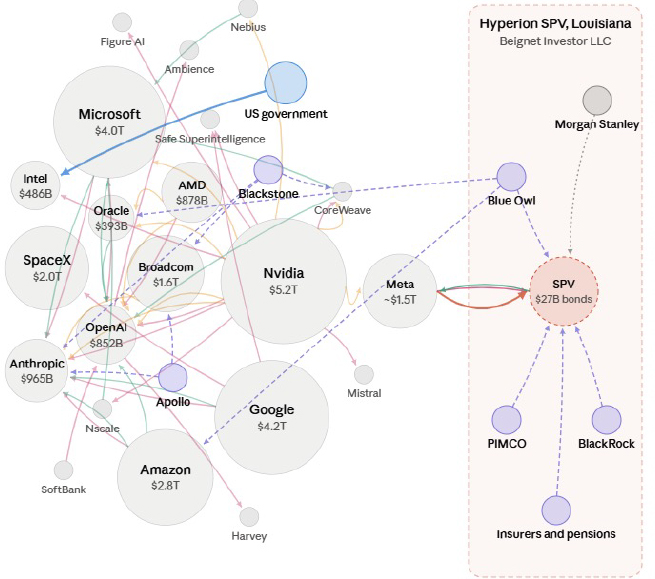
Source: Created with Claude using publicly available sources; deals as reported, values approximate
This material is published solely for the interests of clients and friends of Sentinel Trust Company, L.B.A. and is for discussion purposes only. The opinions expressed are those of Sentinel Trust Company management and are current as of the date appearing in this material and subject to change, without notice. Any opinions or solutions described may not be suitable for investments nor applicable to all scenarios. The information does not constitute legal or tax advice and should not be substituted for a formal opinion. Individuals are encouraged to consult with their professional advisors.
The material is not intended to be used as investment advice, nor should it be construed or relied upon, as a solicitation, recommendation, or any offer to buy or sell securities or products. Any offer may only be made in the current offering memorandum of a fund, provided only to qualified offerees and in accordance with applicable laws. Each type of investment is unique. This material does not list, and does not purport to list, the risk factors associated with investment decisions. There can be no assurance that any specific investment or investment strategy will be profitable and past performance is not a guarantee of future investment results. Before making any investment decisions, you should carefully review offering materials and related information for specific risk and other important information regarding an investment in that type of fund.
Information derived from independent third-party sources is deemed to be reliable, but Sentinel Trust cannot guarantee its accuracy of the assumptions on which such information is based.
[i] https://classics.mit.edu/Aristotle/heavens.1.i.html
[ii] https://www.federalreserve.gov/newsevents/speech/warsh20260828a.htm
[iii] https://www.federalreserve.gov/mediacenter/files/FOMCpresconf20260729.pdf
[iv] https://www.economist.com/finance-and-economics/2026/08/27/scott-bessent-takes-on-the-bond-market
[v] https://www.marketwatch.com/livecoverage/stock-market-today-dow-sp500-nasdaq-called-higher-treasury-yields-fall- cisco-earning/card/treasury-secretary-bessent-calls-himself-nation-s-top-bond-salesman–3KNtdEU0yO3prrecEYEy
[vi] https://www.wsj.com/finance/walter-dodgers-lakers-investigation-3e114ef9?mod=Searchresults&pos=10&page=1
[vii] https://www.economist.com/business/2026/10/15/ai-neolabs-are-raising-huge-sums-most-have-little-to-show-for-it
[viii] https://www.youtube.com/watch?v=zratOmQozBs
[ix] https://www.economist.com/business/2026/02/18/chinas-humanoids-are-dazzling-the-world-who-will-buy-them
[x] https://www.wsj.com/finance/investing/see-the-trump-administration-stock-portfolio-that-spans-more-than-40-companies-efae2bae?mod=WSJ_home_feature_5_pos_1
[xi] https://thecurrency.news/articles/237907/the-connections-that-turned-a-precocious-teen-into-the-fallen-nostradamus-of-ai/
[xii] https://www.rsn.org/001/opposition-to-data-centers-the-issue-uniting-liberals-and-conservatives.html?print=1
[xiii] https://www.wsj.com/finance/broadcom-ceo-intervened-to-seal-63-billion-anthropic-debt-deal-c807754f?mod=hp_lead_pos1
[xiv] https://www.ft.com/content/4ffa1853-0e2c-424f-b941-88c6bcac5765?syn-25a6b1a6=1
[xv] https://www.bloomberg.com/news/articles/2026-10-26/anthropic-ipo-filing-cites-reliance-on-google-amazon-microsoft?srnd=homepage-americas
[xvi] https://www.sec.gov/Archives/edgar/data/2130357/000162828026067168/anthropicpbc-sx1.htm
[xvii] https://www.wsj.com/world/middle-east/u-s-warns-gulf-of-possible-short-intense-renewal-of-iran-war-after-midterms-cd1a55e1?mod=Searchresults&pos=4&page=1
[xviii] https://nypost.com/2026/08/26/health/fda-approves-pancreatic-cancer-drug-that-nearly-doubles-life-expectancy/
[xix] https://www.cnbc.com/2026/04/20/eli-lilly-to-acquire-cancer-drug-maker-kelonia.html